

At the very beginning of 2026, the world seemed to hit fast-forward with AI.
Super Bowl commercials now use AI-generated videos, with real-time effects and smart camera systems becoming standard. Tech giants Meta, Google, and Microsoft are competing in AI-powered search platforms, driving billion-dollar market activity. Enterprise AI tools like Notion AI, Jasper AI, and CodeGPT have become common for team collaboration.
Clearly, AI is enhancing creativity and productivity across industries.
Turning our focus to the fashion industry, the real-world adoption of AI tools brings both challenges and rewards:
- Companies that know how to use AI have saved hundreds of thousands in costs, while others are still paying the price for bad reviews, like products not matching expectations.
- Some professionals worry about being replaced by AI, yet designers who have mastered AI can now generate hundreds of designs daily, dramatically boosting efficiency.
On one hand, the conversation around AI is loud and often overwhelming; on the other, the fashion industry is quietly evolving. So how can we use AI in a way that genuinely improves efficiency without confusion or unnecessary friction?
This article does not dwell on abstract theories. We gathered real insights from fashion designers, pattern makers, e-commerce operators, and factory owners, and selected representative themes. Presented in a Q&A format, it aims to answer the core questions that everyone truly cares about.
Part 1 Why AI-Generated Fashion Looks Fake
Q1: The AI-generated images look obviously fake and fail to meet the demands for commercial-level detail, naturalness, and realism. Is that true?
The answer is—not necessarily. The reason AI images often look fake 90% of the time is due to using the wrong tools or applying them incorrectly.
Take a look at the real complaints from consumers below:
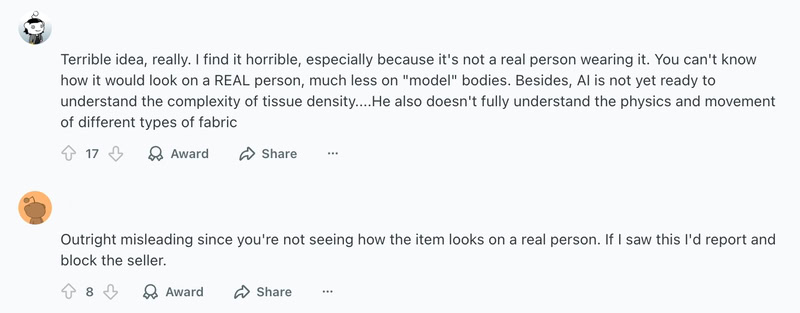
This is perhaps the most common frustration among people using AI fashion design tools. But there are some major misconceptions here:
Misconceptions
- First, consider whether you are using a general-purpose AI model or a fashion-specific tool. Many widely used AI models are like highly skilled but non-specialist artists. They can produce striking conceptual visuals, but often struggle to accurately capture a garment’s structure, drape, folds, and fabric texture.
- Second, if you’ve tried fashion-specific AI tools before, don’t let a single product or an experience from years ago shape your perception of what’s possible today.
AI fashion design tools have evolved rapidly over the past few years. Many of the issues that once caused frustration, such as mannequin-like figures, floating fabrics, or structural inconsistencies, have been significantly reduced thanks to more advanced underlying models.
Today’s AI fashion tools are far more capable than they were just a few years ago, and you may find that the problems you once encountered are no longer dealbreakers.
Part 2 Why the AI Fashion Design Tool Feels Complicated
Q2: AI doesn’t actually improve efficiency—constant revisions and regenerations make the process even more exhausting. What should we do?
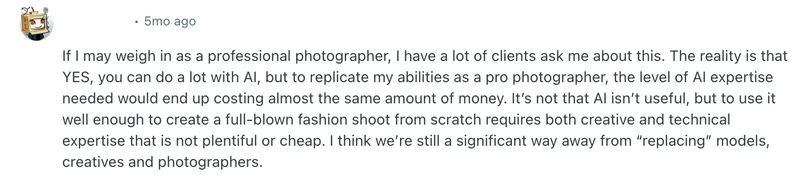
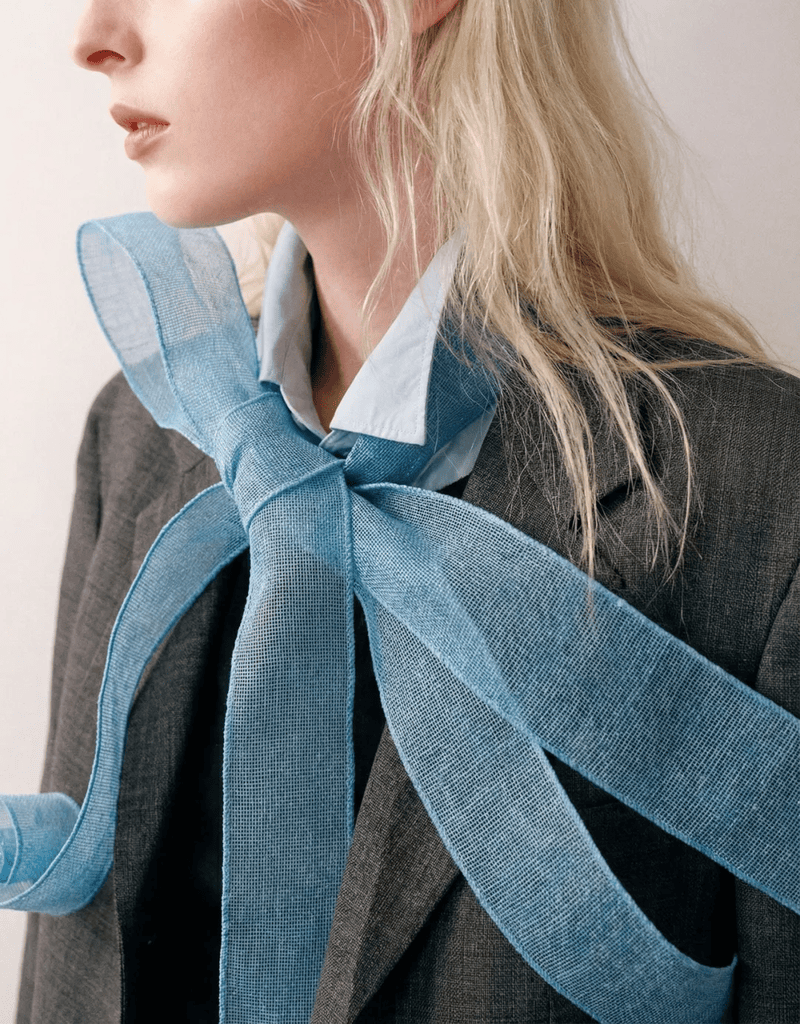
Just as the photographer said in the image above, AI can do a lot, but matching professional fashion photography still requires similar levels of skill and cost.
Many designers complain that using AI design tools involves a complicated workflow:
- launch the tool;
- enter prompts;
- filter results;
- fixi flaws;
- remove watermarks;
- tweak prompts;
- adjust details…
And in many cases, customization options are still limited. After going through the entire process, it can feel even more tiring than designing manually.
But think about it—when you first used AI tools to draft things like annual reports or performance reviews, didn’t it often feel like the AI misunderstood your instructions?
The solution is actually quite simple. If you browse platforms like Reddit, Quora, or TikTok, you’ll find countless prompt-writing techniques for different scenarios. By copying and slightly modifying these prompts, or even asking ChatGPT to refine them, your AI fashion design tool can quickly become a much more responsive and reliable assistant.
At its core, the issue of feeling cumbersome and inefficient using AI is often not about the tool itself, but about the lack of guidance and unfamiliarity with how to use it effectively.
Example
Take a simple example of generating outfit visuals from text prompts. The difference in results can be significant:
Unrefined prompt: A man wearing a light blue suit and a brown shirt.
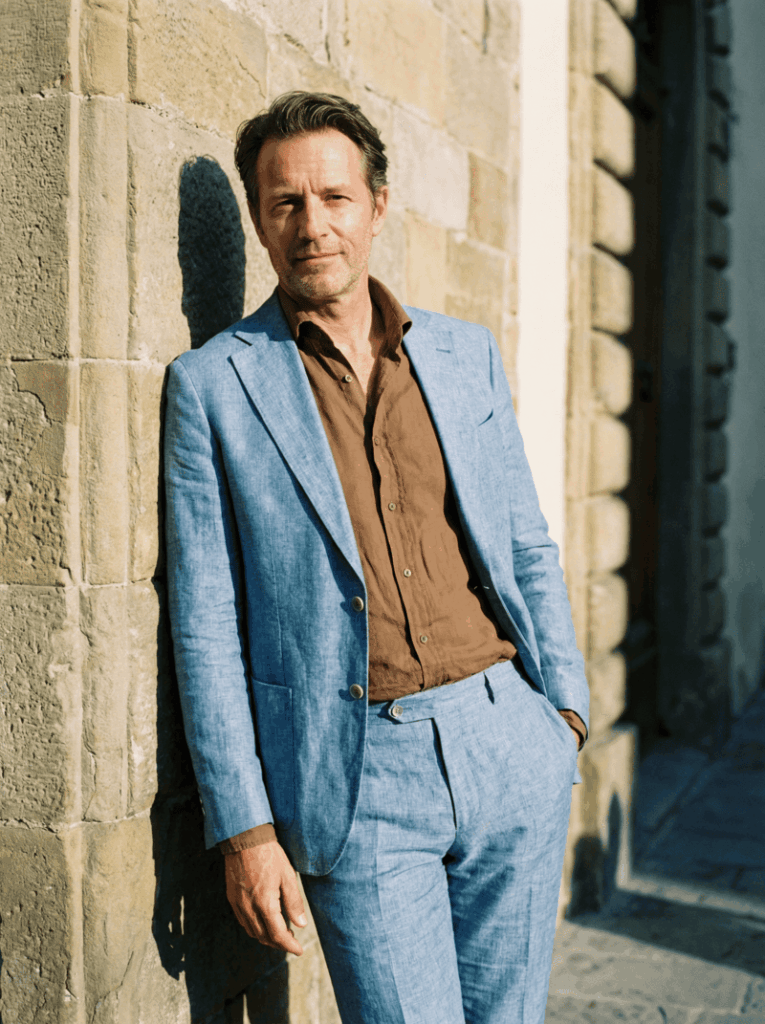
Refined prompt: Generate a light blue suit made of denim fabric, paired with a brown knit sweater featuring a semi-turtleneck. The style should resemble Balenciaga. A male model is wearing the outfit, set against a clean white background.
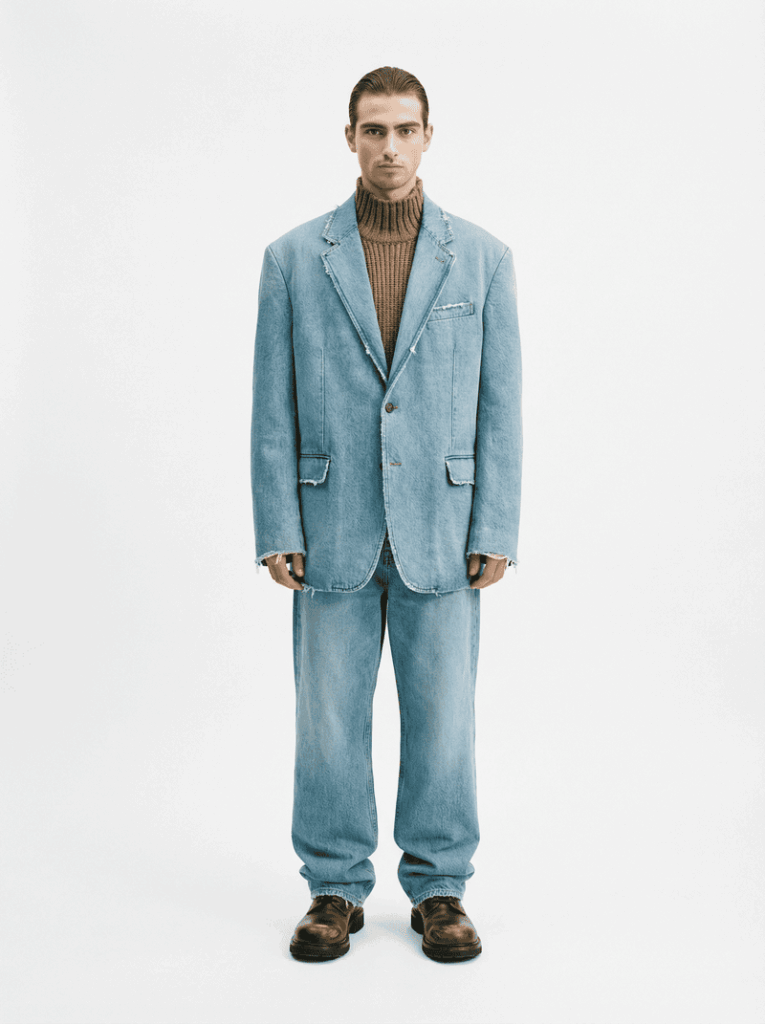
You can easily compare the results yourself. The better you understand how to write AI outfit prompts, the more effectively you can use AI design tools.
While AI fashion tools can feel complicated at first, some platforms simplify the entire process. Take Fashion Diffusion, for example, it offers not just a product but a complete service system to guide you step by step:
- Built-in intelligent prompt generation system and tutorial videos;
- Dedicated 1-on-1 support to guide you through the process and answer questions;
- Training sessions with step-by-step guidance to help you generate precise results and fully master the tool.
Part 3 Do Better AI Images Lead to More Returns
Q3: The better AI-generated product images look, the higher the return rates? When expectations are set too high, and the actual product falls short, how can brands strike a balance?
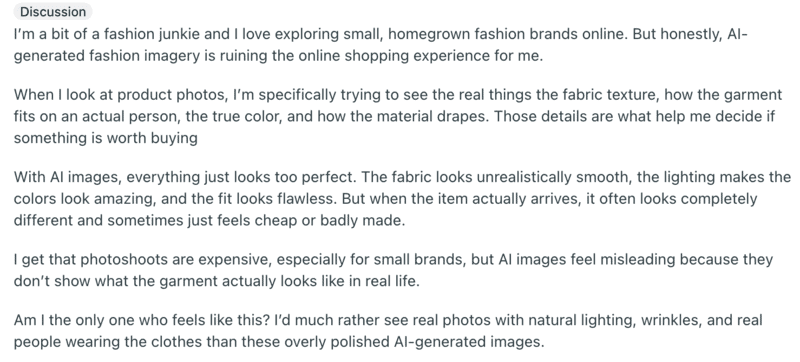
Concerns about AI-generated product images are easy to find online.
Issues like mismatched expectations, color discrepancies, and differences between images and the actual product are common pain points that can lead to returns, and high return rates are something no business wants to see.
Just as the rise of ChatGPT sparked concerns about authenticity in writing and information, it’s inevitable that AI fashion, as a new form of productive technology, will face skepticism.
However, it’s still important to stay clear on one point: AI in design is not meant for over-enhancement or deception, but for reducing costs and improving efficiency.
What AI fashion design tools aim for is not an unrealistic level of beauty that exceeds the actual product, but a more cost-effective form of realism.
Part 4 How to Choose the Right AI Tool
Q4: With so many AI fashion tools on the market, affordable options often fall short, while the more capable ones can be expensive. Some are easy to learn but hard to put into practice, while others are powerful but not user-friendly. How should I choose?
For fashion professionals, the cost of trial and error is extremely high, covering time, labor, team morale, and even potential risks to orders. So choosing the right AI fashion design tool is very important.
While we offer Fashion Diffusion, an AI design tool tailored for the fashion industry, we are not here to put down other products or oversell our own. Instead, we believe the choice should be yours.
Fashion Diffusion offers four core capabilities:
- AI image generation;
- Precise style editing;
- Cost-efficient design testing and iteration;
- AI-powered commercial photography.
It also supports 4K image output, AI video generation, complex fabric rendering on models, virtual models, and a wide range of advanced features.
Examples
Below are some examples of commercial visuals created with Fashion Diffusion. With the Virtual Try-On feature, garments can be seamlessly applied to models, providing a clear and realistic view of how the clothing looks when worn, including fabric behavior and fit.
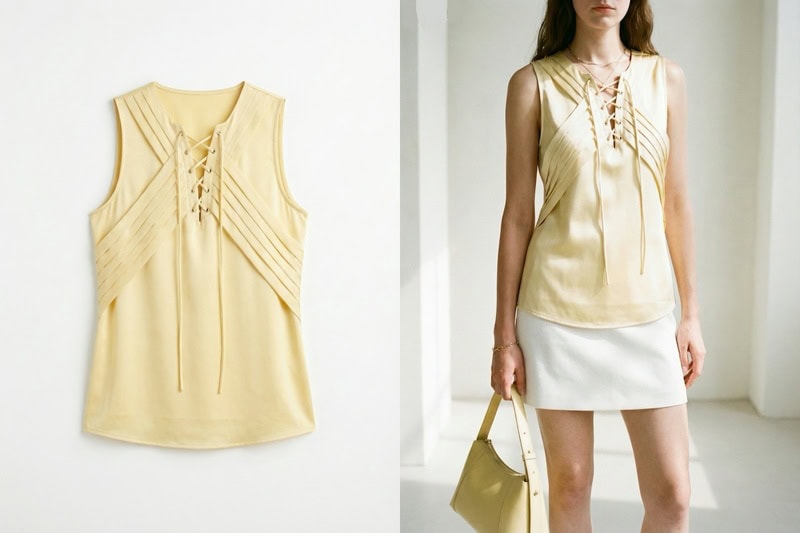
Even flat-lay designs are rendered with a high level of accuracy, preserving garment construction details and fabric characteristics. This allows consumers to better understand the actual wearing effect, helping reduce returns caused by mismatched expectations.
Another key feature is AI Lookbook generation. Fashion Diffusion can produce a full set of product images within minutes.
A single design can be presented from multiple angles, with flexible options to adjust model poses, swap models, change backgrounds, and highlight specific details, making it easy to create versatile, scenario-based, and highly customized visuals.
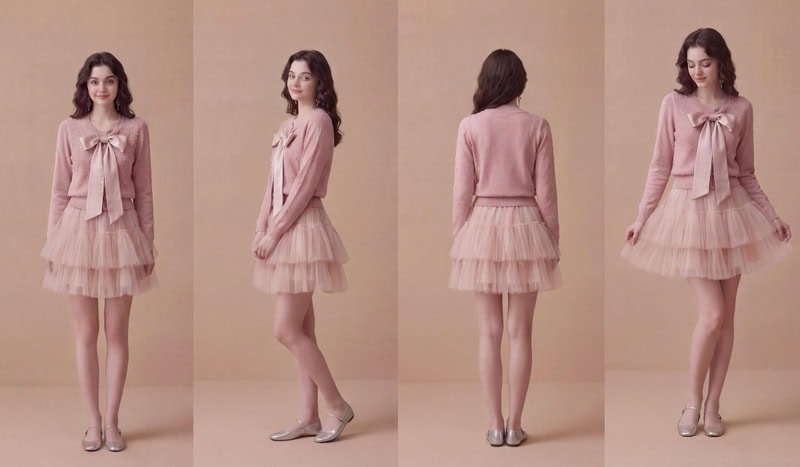
If further refinement is needed, AI Inpainting can be used to adjust specific areas, or users can upload reference images of similar styles for Style Innovation.
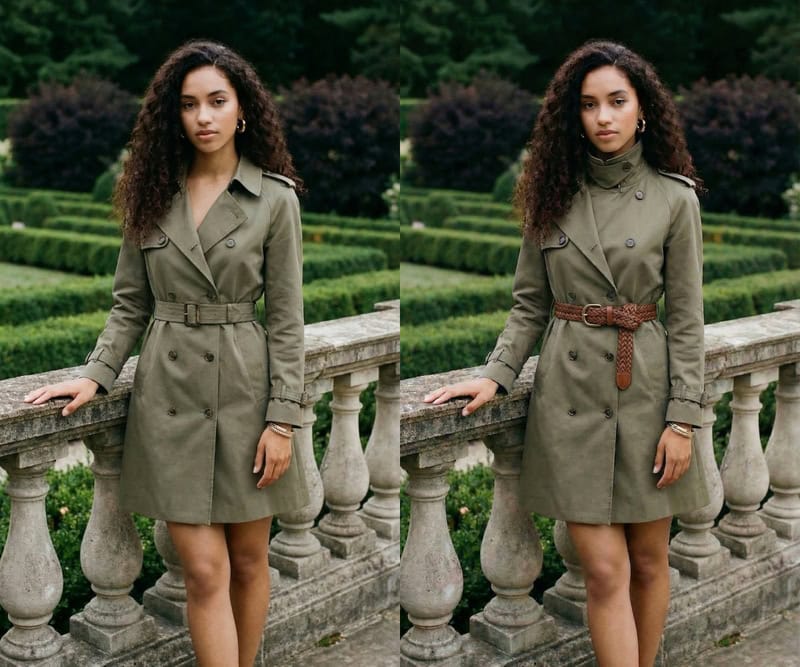
Fashion Diffusion is more than just a tool for design and commercial visuals. It serves as a connected system for inspiration capture, AI generation, and trend validation, helping turn data-driven insights into successful, market-ready designs.
Part 5 What AI Really Brings to Fashion Businesses
Q5: AI is often overhyped, but what tangible impact can it actually bring to fashion businesses?
To answer this question, the image below provides a clear explanation:
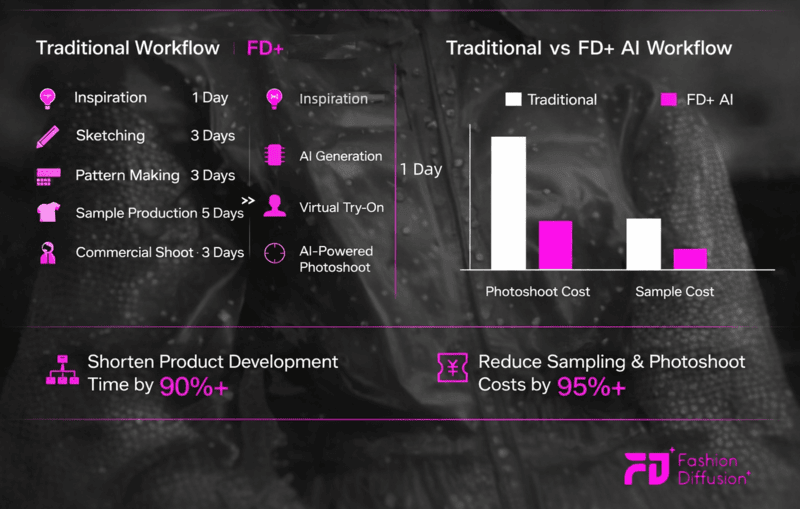
The traditional design process is often complex, with mass production taking several weeks. From creating sketches to producing sample garments and conducting model-based commercial shoots, every step can be both time-consuming and expensive.
For fashion businesses operating across borders, coordinating international models and securing appropriate shooting locations adds an extra layer of challenge. And even with all that time and financial investment, sales are never guaranteed.
What AI tools offer is a significantly shorter production cycle, along with cost savings of over 95%.
Whether for product launches or testing new designs, AI enables a more cost-effective approach. For both business owners and front-line professionals, it’s a win-win solution.
Conclusion
AI is no longer just a concept—it’s a new driver of productivity.
Yet fashion has its own rules: fabric, fit, craftsmanship, models, production, and trust. These fundamentals cannot be bypassed by AI. The resistance isn’t to AI itself, but to AI that feels impractical, unprofessional, overly complex, risky, or unsupported.
Fashion Diffusion was created to change that. It’s an AI design partner that truly understands fashion, production, and you. We are here to guide you through this shift in fashion design and commercial production, helping you move forward with clarity and confidence.
If you’ve been exploring AI fashion or feel limited by the tools you’ve tried, there’s no better time to see what’s possible. Experience Fashion Diffusion and discover the difference for yourself!


