

Futuristic fashion in 2026 isn’t about costume or sci-fi theatrics. It’s a wearable aesthetic — metallic fabrics, architectural silhouettes, holographic prints, and smart materials — that sits at the intersection of design precision and technological possibility.
This guide covers what futuristic fashion actually looks like today, the five defining outfit directions of 2026, and how to use AI to design and visualize your own futuristic looks — from first concept to photorealistic model shot.
What Is Futuristic Fashion?
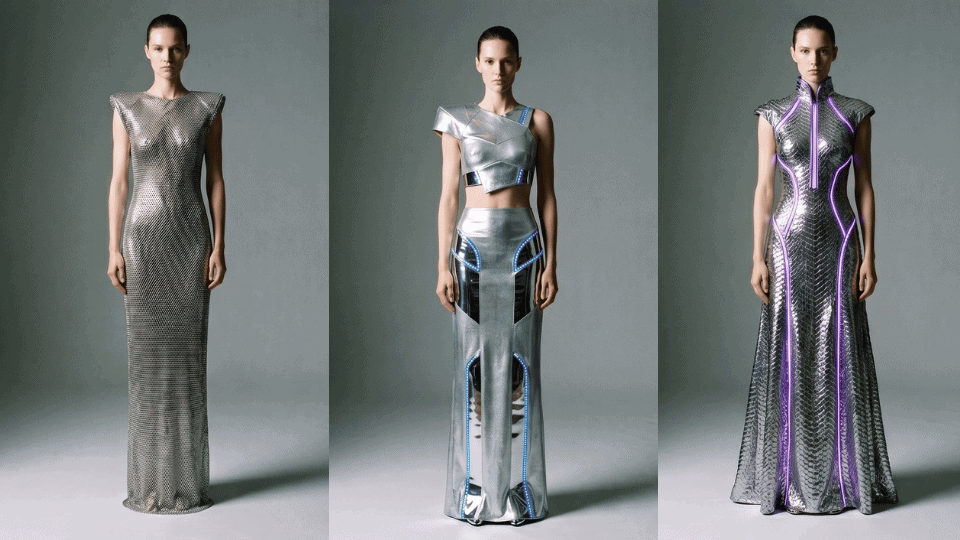
Futuristic fashion is a design aesthetic built around clean lines, advanced materials, and subtle technology — not the exaggerated, dystopian look of science fiction. Think of it as dressing for a version of tomorrow that is still elegant and wearable today.
The simplest way to understand it:
Futuristic Fashion = Minimalism + Advanced Materials + Precision Tailoring
It’s defined by what it removes as much as what it adds. Excessive ornamentation is replaced by structural form. Traditional fabrics give way to metallics, iridescent weaves, and smart textiles. Hardware becomes invisible or architectural.
How Futuristic Fashion Differs from Sci-Fi or Cyberpunk Style
A common confusion is treating futuristic fashion and cyberpunk as the same aesthetic. They’re not.
| Futuristic Fashion | Cyberpunk / Sci-Fi Style | |
|---|---|---|
| Wearability | High — designed for real-world luxury contexts | Low — theatrical, often costume-like |
| Aesthetic | Clean, minimalist, polished, tailored | Gritty, dystopian, maximalist |
| Technology | Subtly integrated, enhances function | Overt — exposed wires, visible tech |
| Materials | Metallics, smart fabrics, sustainable tech | Industrial, raw, synthetic |
Futuristic fashion belongs in luxury showrooms and editorial shoots. Cyberpunk belongs on a film set. Both are interesting — but they serve completely different creative purposes.
Key Elements of Futuristic Fashion
1. Clean Lines and Architectural Silhouettes
Futuristic fashion favors precision. Cuts are sharp. Silhouettes are structural. The garment’s form is the statement — not embellishment, not print, not layering.
This is where AI design tools are particularly useful. Generating clean architectural silhouettes from a prompt or sketch takes seconds, letting designers explore dozens of structural variations before committing to a direction.
2. Metallic and Iridescent Fabrics
Chrome, liquid silver, holographic weaves, and color-shifting iridescent fabrics are the signature materials of the aesthetic. They interact with light dynamically — the garment looks different from every angle, in every setting.
For e-commerce and editorial use, these materials are notoriously difficult to photograph accurately. Apply Fabric lets you upload a metallic or iridescent fabric swatch and apply it directly to any garment silhouette, making it possible to see how a holographic piece will look without a physical sample.
3. Smart and Sustainable Materials
In 2026, tech-integrated clothing is moving from novelty to function. Smart fabrics can regulate temperature, respond to movement, and wick away moisture without changing how clothes look or feel — through conductive yarns, responsive fibers, and embedded sensors.
Futuristic fashion incorporates these materials into elevated silhouettes: lab-grown silk with thermal regulation, recycled ocean plastics engineered to a luxurious finish, biodegradable polymers cut like high-end tailoring.
4. A Disciplined Color Palette
The base is almost always neutral: deep black, glowing white, refined gray. Color comes from metallics and holographic effects — not from print or pigment. The contrast between the neutral structure and the light-reactive surface treatment is what gives the look its signature tension.
5 Futuristic Fashion Outfit Ideas for 2026
The aesthetic spans a wide range — from understated metallic minimalism to bold holographic statements. What follows are five distinct directions, each grounded in the core principles of clean silhouettes, advanced materials, and deliberate restraint. Use them as a starting point for your own designs, or as a reference for what’s shaping the futuristic fashion conversation in 2026.
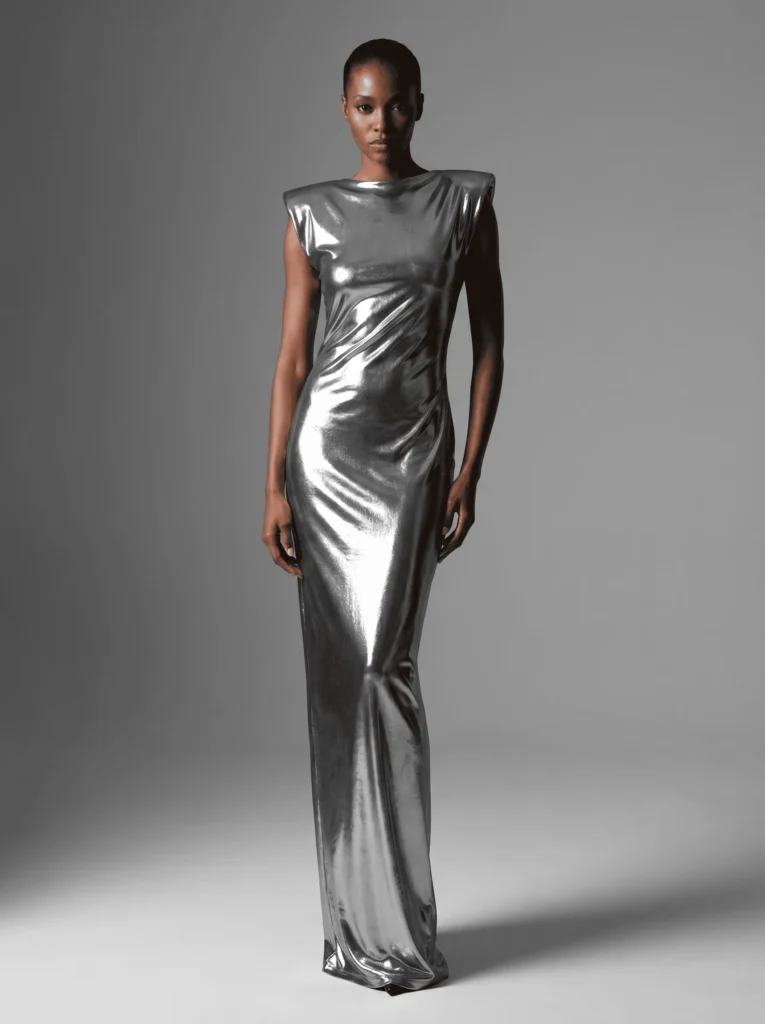
1. Minimalist Metallic Ensemble
The look: A sleek silver column dress or chrome-finish trouser suit in liquid metal fabric. Minimal seaming. No visible hardware. The garment’s surface does all the work.
Styling direction: Keep accessories architectural — geometric earrings, a single cuff. Let the fabric be the focus.
2. Holographic and Digital Print Statement
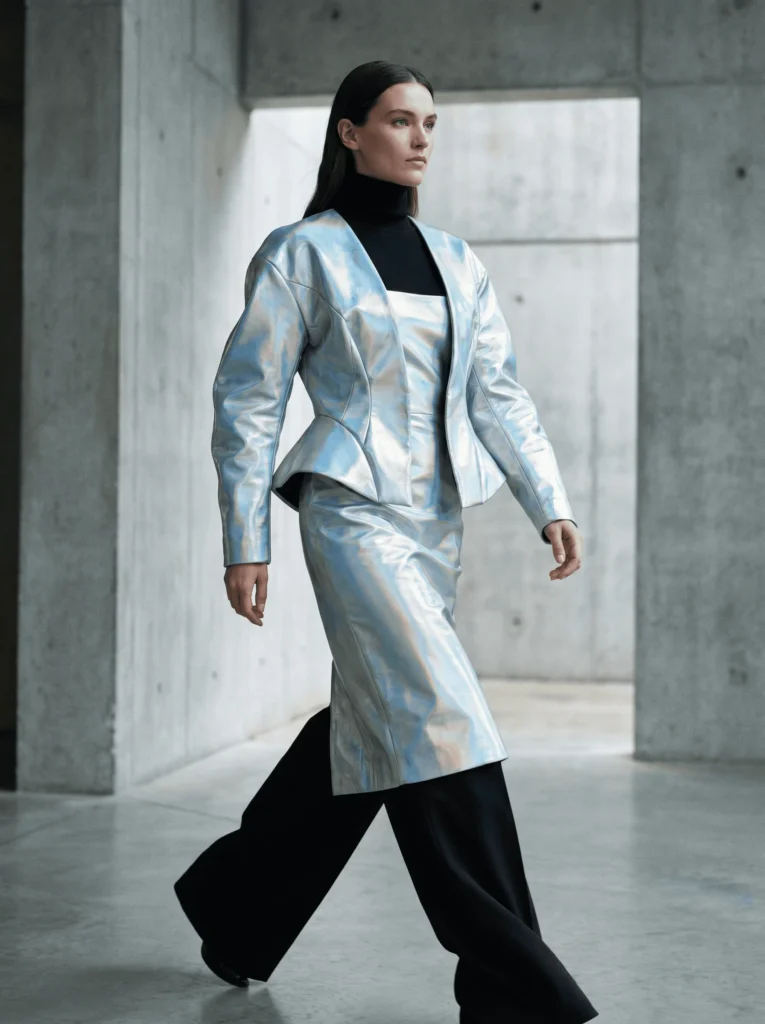
The look: A structured jacket or dress in holographic fabric that shifts between iridescent blue, silver, and pale gold as it moves. Paired with clean matte black separates underneath to let the surface effect breathe.
Styling direction: One holographic piece per outfit. Pair with matte, structural separates — the contrast makes the iridescent piece hit harder.
3. Architectural Smart-Fabric Suiting
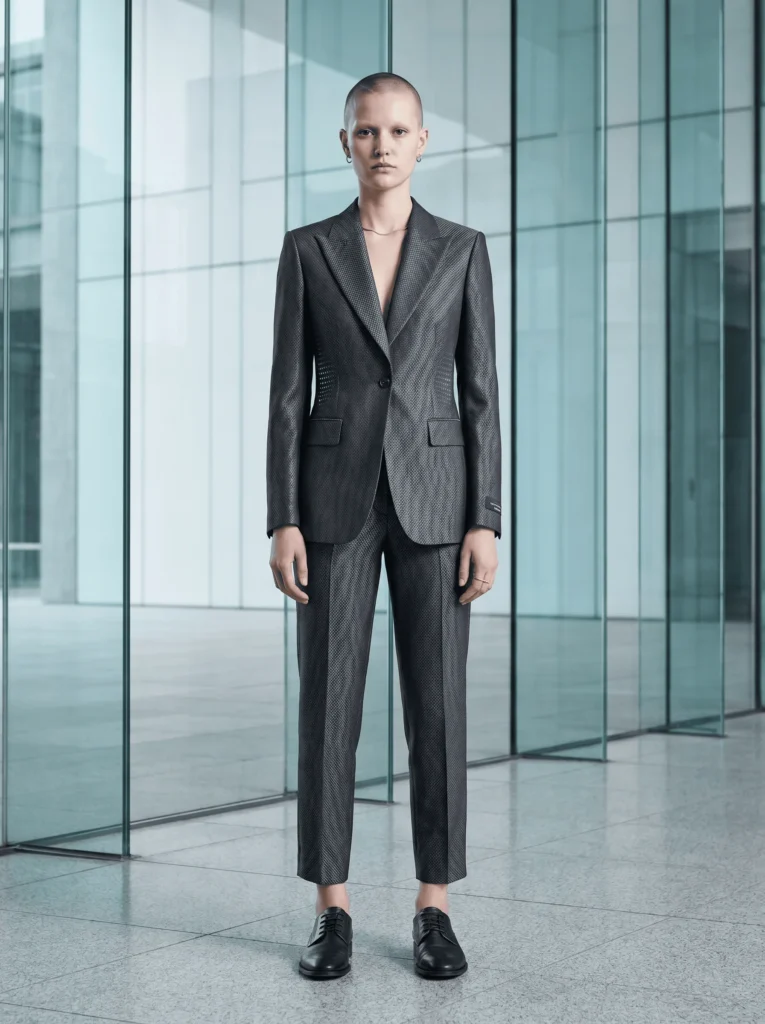
The look: A precisely tailored suit in temperature-regulating or adaptive fabric — structured enough for formal settings, technical enough to signal the futuristic aesthetic. Sharp lapels, clean trouser break, no excess fabric.
Styling direction: Minimal hardware, invisible closures. The sophistication is in the construction, not the accessories.
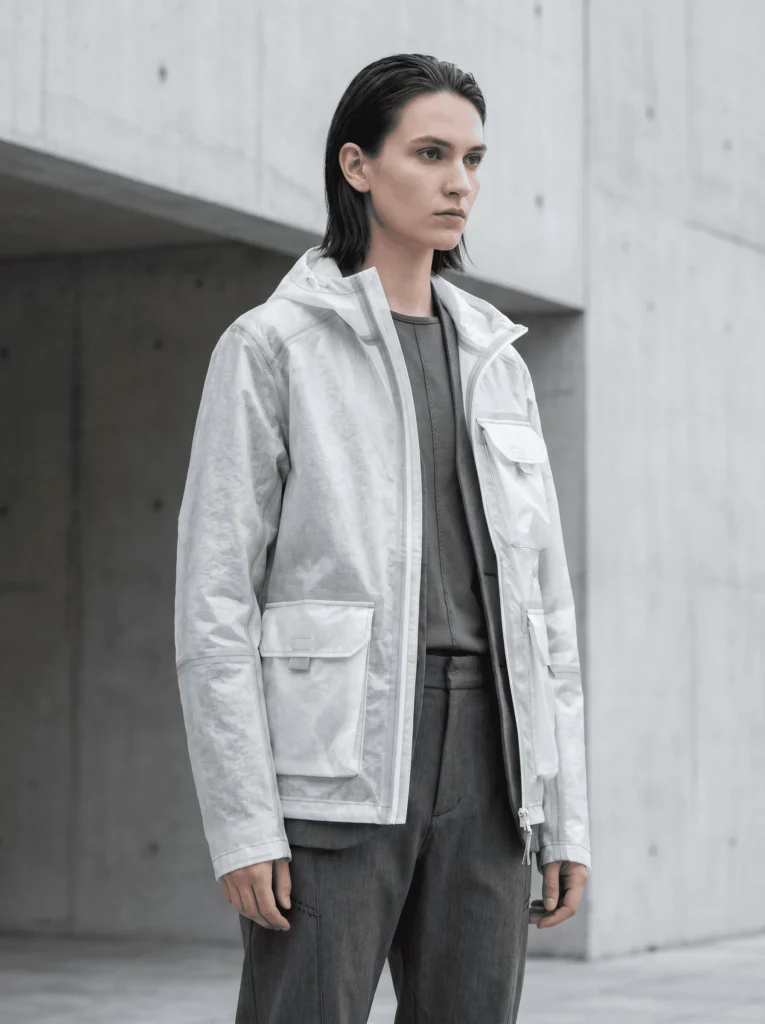
4. Eco-Tech Layered Look
The look: A biodegradable polymer outerwear piece over a recycled-material base layer — both in the futuristic neutrals palette (white, pale gray, off-black). The construction shows deliberate sustainability: visible seam structure, functional pockets, no decorative elements.
Styling direction: Let the construction details tell the sustainability story — visible seams, raw edges treated with precision rather than hidden.
5. Digital Pattern and 3D-Print Detailing
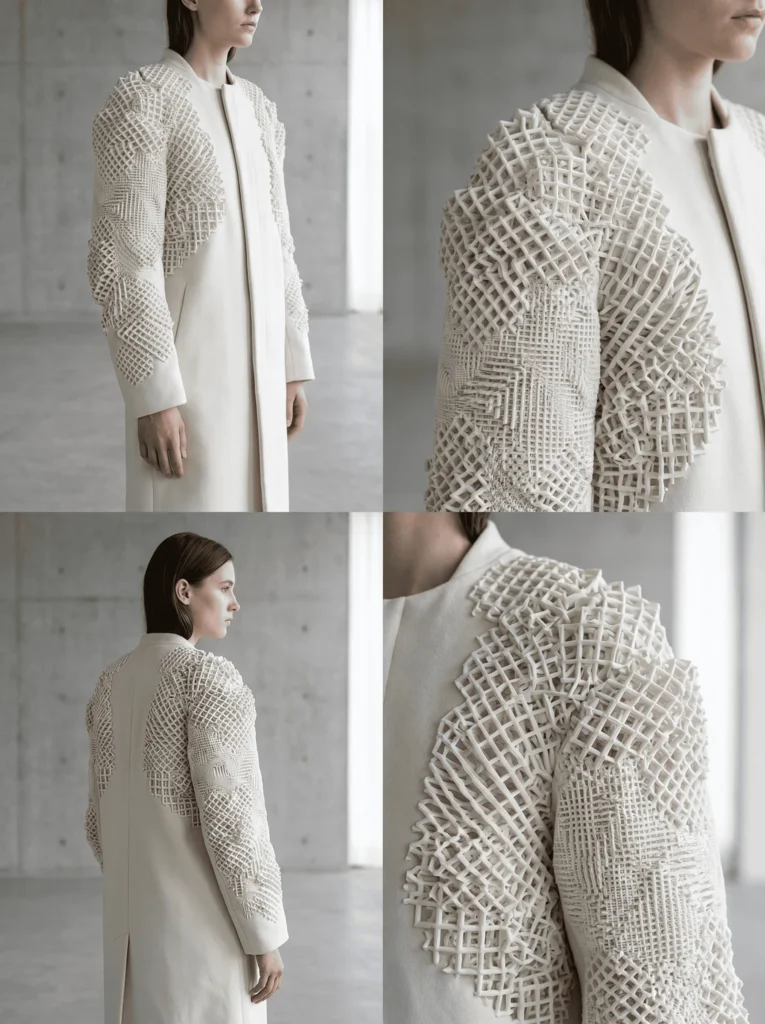
The look: A garment featuring AI-generated geometric patterning or 3D-printed structural detailing — textures that couldn’t exist with traditional manufacturing. The base form is clean and minimal; the surface complexity is the design statement.
Styling direction: Let the pattern or texture carry the outfit. Keep silhouette simple — fitted, column, or structured — so the surface complexity reads clearly.
How to Create Futuristic Fashion Looks with AI
The five outfit directions above illustrate what’s possible. Here’s a practical workflow for building your own futuristic fashion visuals from start to finish using Fashion Diffusion.
Step 1: Generate the Concept
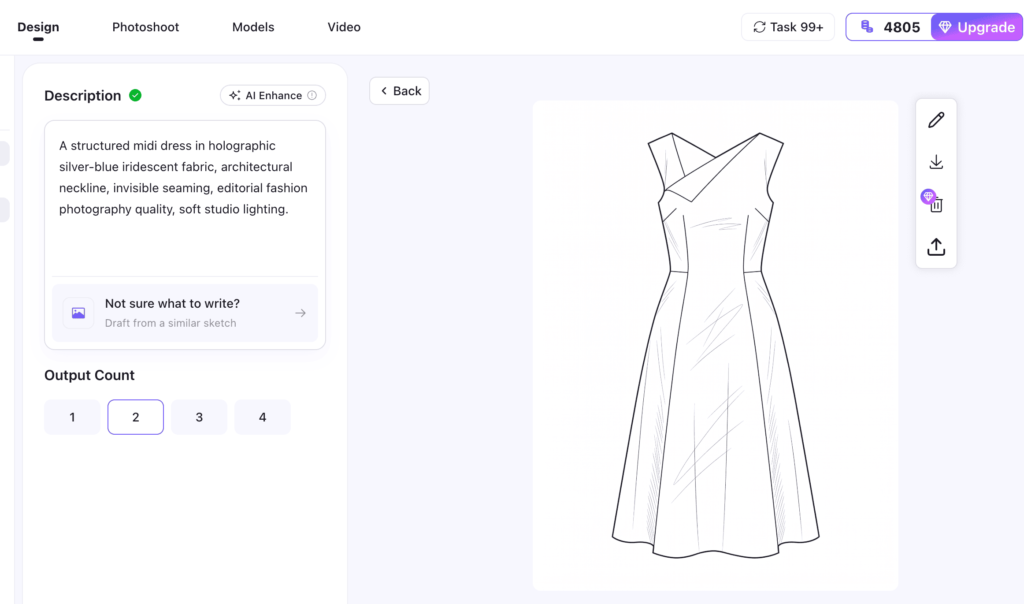
Start with a text description of the look you want. Be specific about silhouette, fabric, color, and construction:
“A structured midi dress in holographic silver-blue iridescent fabric, architectural neckline, invisible seaming, editorial fashion photography quality, soft studio lighting.”
Use AI Outfit Generator for full-look generation, or AI Text to Sketch if you want to start with a line drawing you can develop further.
Step 2: Develop the Design
Once you have a base concept, iterate:
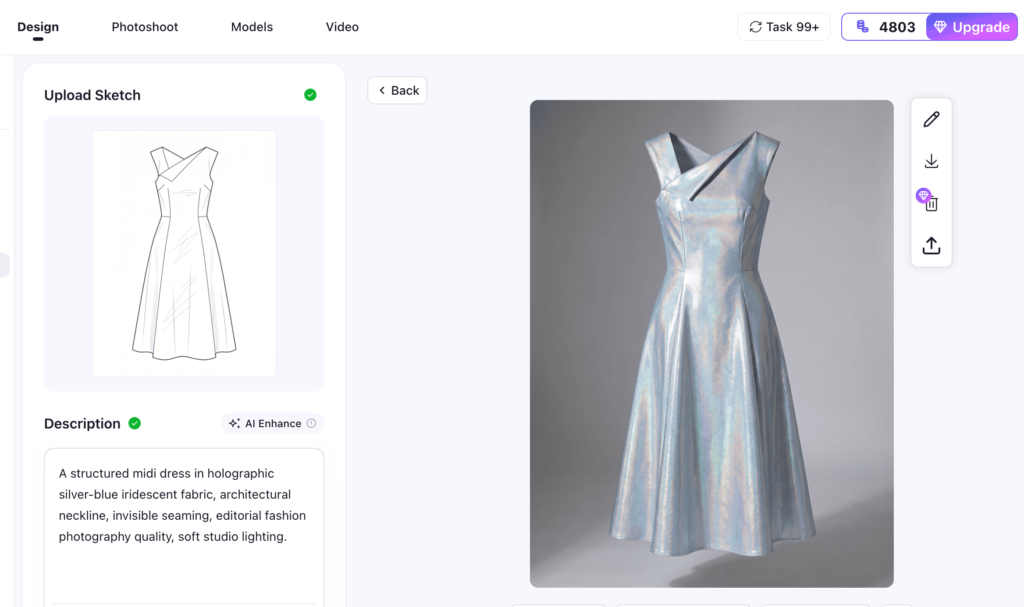
- Sketch to Render — Convert a hand-drawn or digital sketch into a photorealistic fashion image
- Apply Fabric — Test metallic, holographic, or smart fabric swatches on your design
- Recolor — Explore the neutral + metallic accent palette without redrawing
- Seamless Pattern Generator — Create geometric or AI-generated prints to apply to the garment
Step 3: AI try on a Model
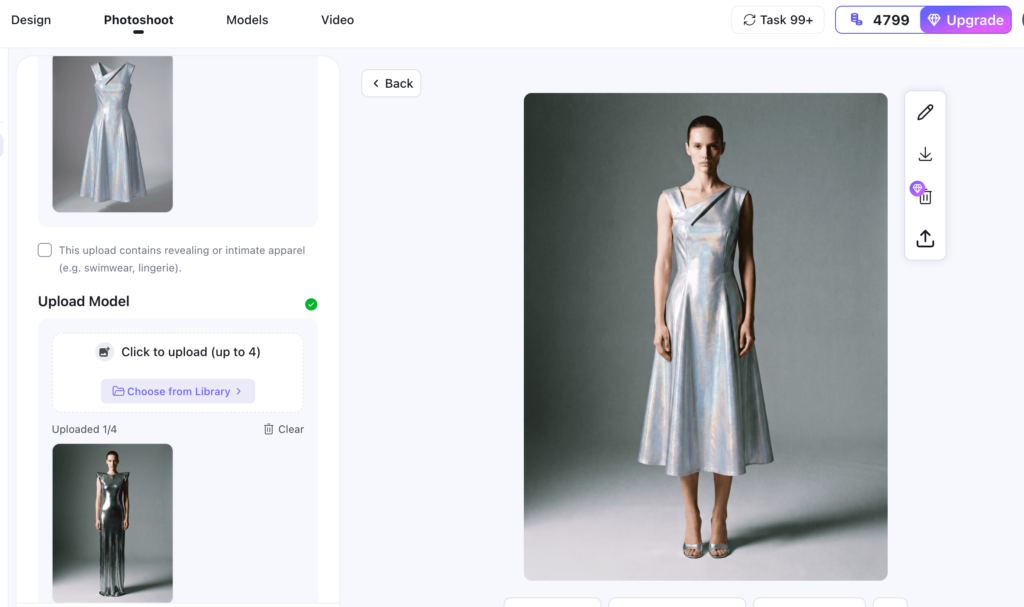
Take the finished design into Virtual Try-On. Upload a flat-lay of the garment, pick a model, and generate a studio-quality on-model photo in seconds.
Step 4: Create Campaign Visuals
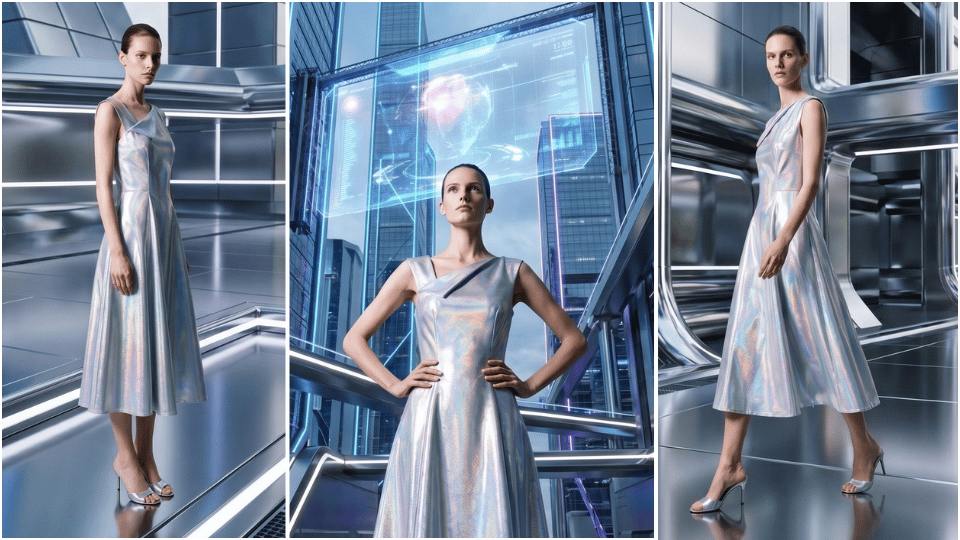
For editorial or social content, use Change Background to place the model in a minimalist studio, urban architecture setting, or abstract digital environment — whichever fits the campaign direction.
Turn the final image into video content with AI Fashion Video: describe the motion (slow pan, fabric ripple, structural turn) and generate a publish-ready clip for TikTok or Instagram Reels.
Why AI Is the Right Tool for Futuristic Fashion Design
Futuristic fashion is hard to design conventionally. The materials don’t exist in swatchbooks. The silhouettes require precision that sketching by hand approximates at best. Physical sampling of metallic or smart-fabric garments is expensive and slow.
AI removes these friction points:
- Speed: A new silhouette concept takes seconds to generate, not hours to sketch and render manually
- Material visualization: Metallic, holographic, and iridescent fabrics render accurately without physical samples
- Iteration cost: Testing 10 colorways or 5 silhouette variations costs the same as testing one
- Photography: On-model product shots and campaign visuals are generated within the same platform, without a studio
For designers working in this aesthetic, the creative bottleneck isn’t ideas — it’s production. AI closes that gap.
Design Your Own Futuristic Fashion Look with AI
Whether you’re developing a collection concept, creating product visuals for a metallic capsule, or exploring new silhouette directions — AI removes the friction between the idea and the image.
Fashion Diffusion covers the full futuristic fashion workflow: from text prompt to finished design, on-model photography, and campaign video. No studio, no samples, no waiting.
Start designing with Fashion Diffusion — free trial →
Futuristic Elegance FAQs
Futuristic fashion is a wearable aesthetic built around clean architectural silhouettes, metallic and iridescent fabrics, smart materials, and subtle technology integration. Unlike sci-fi or cyberpunk style, it prioritizes sophistication and real-world wearability over theatrical effect.
The dominant directions in 2026 are metallic minimalism (chrome, liquid silver, holographic fabrics), smart-fabric suiting with performance properties, eco-tech layering using sustainable advanced materials, AI-generated geometric patterning, and architectural 3D-printed detailing. All share the same foundation: clean silhouettes with technically advanced surfaces.
Futuristic fashion is polished, minimalist, and luxury-adjacent — designed for real-world wear in elevated contexts. Cyberpunk is gritty, maximalist, and dystopian — closer to costume than clothing. The two aesthetics share an interest in technology and the future, but diverge entirely in execution and intention.
The signature materials are metallics (chrome, liquid silver, foil-printed fabrics), iridescent and holographic weaves that shift color with light and movement, smart fabrics with thermal regulation or adaptive properties, and sustainable innovations like lab-grown silk and biodegradable polymers finished to a luxury standard.
Yes — AI tools like Fashion Diffusion are well-suited to this aesthetic. You can generate metallic and holographic garment visuals from text prompts, apply specific fabric swatches to silhouettes, create AI-generated geometric patterns, and visualize the finished look on a realistic AI model. The full workflow from concept to photorealistic model shot takes minutes.


