

What if designing a T-shirt wasn’t about mastering software, but about exploring ideas?
Whether you are an independent creator testing print-on-demand ideas, a streetwear brand exploring rapid drops, or a fashion team experimenting with generative workflows, AI T-shirt design offers a scalable way to move from concept to visual validation.
AI T-shirt design shifts the focus from technical execution to creative experimentation. Instead of being limited by tools, designers can generate multiple graphic concepts instantly, test logo variations, and visualize finished shirts in realistic settings. All within a streamlined workflow.
In this article, you will discover how AI T-shirt design works, how it compares to traditional design methods, and how to create production-ready T-shirt graphics step by step using AI fashion design generators.
What Is AI T-shirt Design
AI T-shirt design refers to the process of using artificial intelligence tools to create and develop T-shirt graphics, logos, and visual concepts. Instead of relying entirely on manual illustration or complex design software, AI systems can generate design ideas based on text prompts, visual inputs, or stylistic references.
Rather than being a single tool, AI fashion design represents a broader shift in how apparel graphics are created, emphasizing speed, experimentation, and digital-first workflows. As demand for faster product cycles and flexible design processes continues to grow, AI-driven design is becoming an increasingly practical solution for creators and brands alike.
Why AI T-shirt Design Is Growing Rapidly
The rapid growth of AI T-shirt design is not accidental. It reflects larger shifts in the fashion and e-commerce landscape, where speed, flexibility, and digital efficiency have become competitive advantages.
Several key factors are driving this momentum:
1. Faster Product Cycles
Fashion trends move quickly, especially in streetwear and online retail. Brands that once launched seasonal collections now release new drops weekly or even daily. AI allows designers to generate and test concepts rapidly, reducing the time between idea and launch.
2. The Rise of Print-on-Demand
Print-on-demand businesses have lowered the barrier to entry for apparel entrepreneurship. However, they require a constant stream of new designs to stay competitive. AI makes it possible to experiment with multiple graphic variations without hiring external designers for every concept.
3. Demand for Customization and Niche Designs
Consumers increasingly expect personalized or niche-focused products. From micro-communities to fandom-based merchandise, small-batch creative output is in high demand. AI enables scalable experimentation across styles, aesthetics, and audience segments.
4. Lower Design Barriers
Traditional T-shirt design often requires advanced tools such as Illustrator or Photoshop. AI reduces the technical barrier, allowing creators to focus on ideas rather than software complexity.
AI T-shirt Design vs Traditional T-shirt Design
To understand why AI adoption is accelerating, it helps to compare it directly with traditional design workflows.
| Aspect | Traditional Design | AI T-shirt Design |
| Concept Development | Manual sketching & drafting | Prompt-based generation |
| Iteration Speed | Slow revision cycles | Instant regeneration |
| Color Variations | Manual recoloring | Multiple variations in seconds |
| Skill Requirement | Professional software knowledge | Accessible to beginners |
| Product Preview | Manual mockup creation | Instant on-garment previews |
The key difference lies in iteration speed and flexibility. Traditional workflows are often linear, while AI-driven workflows are iterative. This shift is what makes AI design (including AI T-shirt, shirt, sweatshirt design) particularly suited for modern digital commerce environments.
How to Create an AI T–shirt Design (Step-by-Step Workflow)
Creating a high-quality AI T-shirt design can be structured into four focused stages: concept generation, graphic development, placement, and refinement.
Using Fashion Diffusion, you can move efficiently from initial idea to a production-ready T-shirt mockup within a streamlined workflow.
Step 1: Generate the Full T-shirt Concept
Begin with the AI Outfit Generator and define the overall design direction.
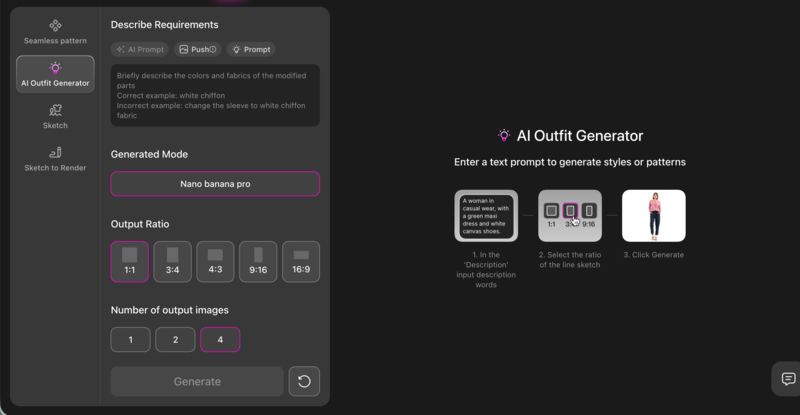
At this stage, the goal is to establish silhouette, fabric texture, graphic style, and presentation mood in one cohesive concept.
When writing your prompt, clearly describe:
- Silhouette (oversized, boxy, relaxed, structured);
- Fabric quality (heavyweight cotton, washed texture, smooth premium finish);
- Graphic type (abstract, geometric, illustrated, experimental);
- Presentation style (studio product shot, fashion editorial, ecommerce-ready).
Generate multiple variations and evaluate overall balance, composition, and visual clarity before moving forward.
Below are several strong graphic directions you can explore.
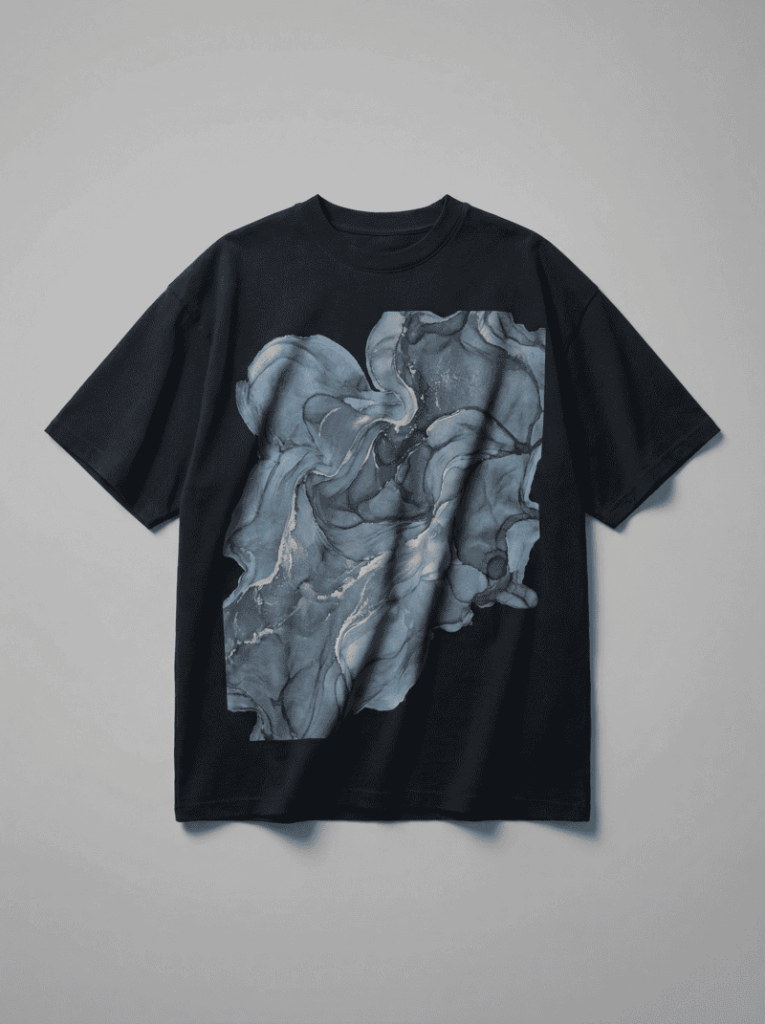
Option 1: Abstract Art Graphic Concept
This direction focuses on expressive abstract composition. Layered organic shapes, fluid transitions, and controlled color palettes create visual depth while maintaining balance. Muted tones or metallic accents can add refinement without overwhelming the garment.
Example prompt: oversized black streetwear t-shirt, large abstract fluid art print on chest, layered organic shapes in muted blue and silver tones, balanced composition, heavyweight cotton texture, realistic fabric folds, soft studio lighting, professional fashion product photography, ultra detailed.
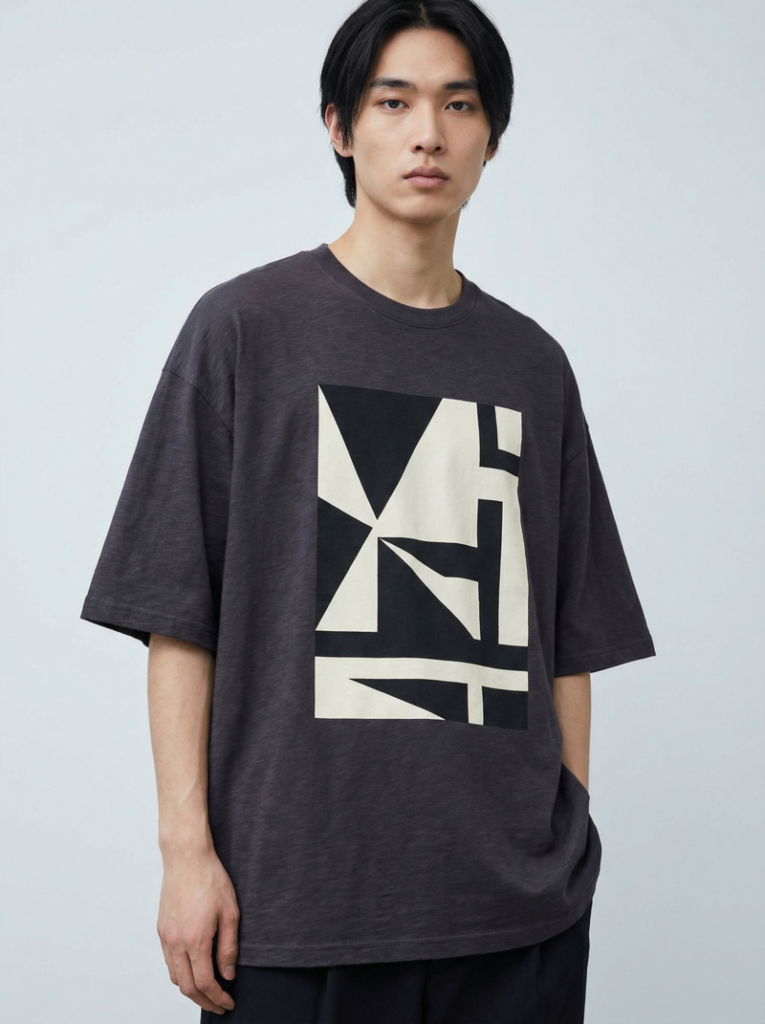
Option 2: Modern Geometric Graphic Design
Geometric compositions emphasize structure and clarity. Clean lines, bold shapes, and asymmetrical layouts create a strong focal point with minimal visual noise. High-contrast palettes enhance print sharpness and readability.
Example prompt: boxy oversized t-shirt in deep charcoal, bold geometric graphic print centered on chest, asymmetrical layout, high contrast black and off-white palette, premium cotton fabric texture, clean studio background, fashion lookbook photography, ultra realistic.
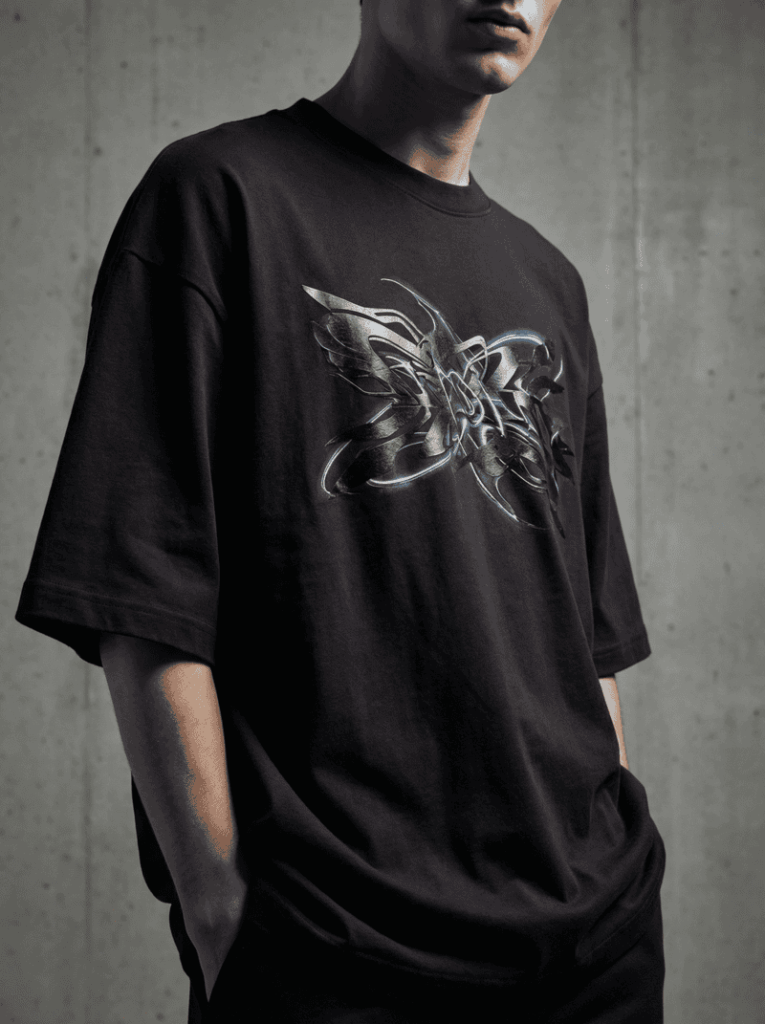
Option 3: Futuristic Abstract Pattern
This direction leans toward experimental and forward-looking aesthetics. Layered textures, metallic finishes, and controlled glow effects create a bold yet cohesive design suitable for contemporary streetwear collections.
Example prompt: oversized streetwear t-shirt in matte black cotton, futuristic abstract pattern print across chest, layered metallic textures and subtle glow accents, strong visual contrast, realistic fabric folds, cinematic studio lighting, fashion editorial photography, 4k detail.
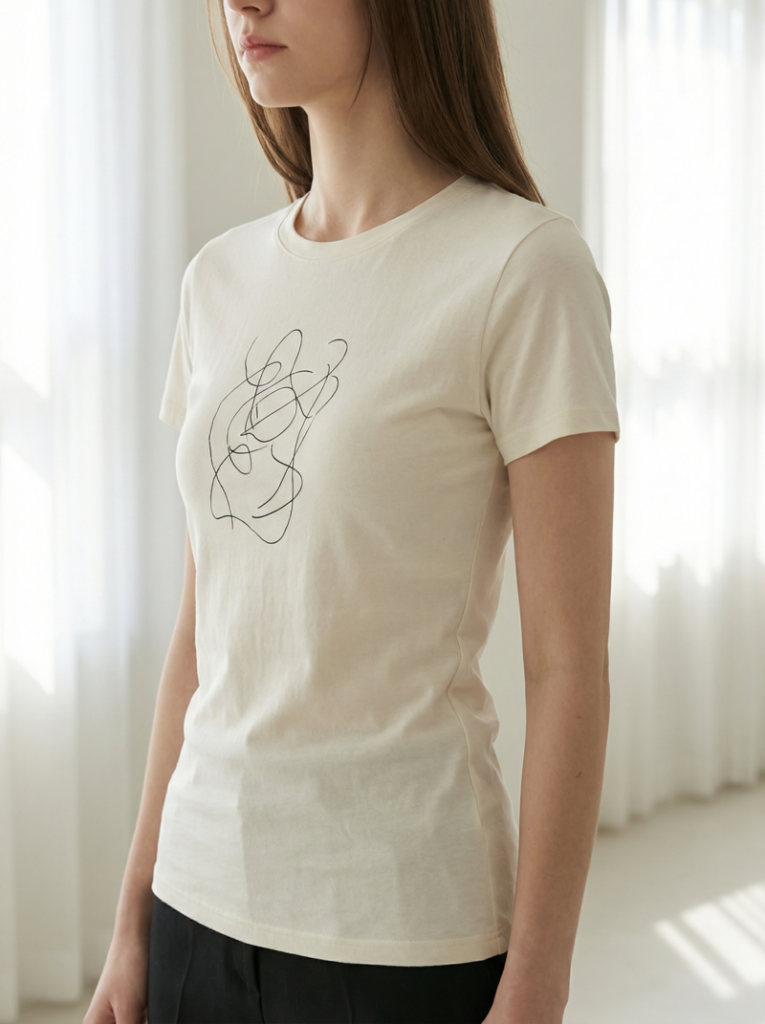
Option 4: Feminine Fitted Minimal
This direction focuses on a refined, body-contouring silhouette with subtle graphic expression. Clean waist shaping, lightweight cotton, and minimal line-based artwork create a modern and wearable design suitable for contemporary womenswear brands.
Example prompt: fitted women’s t-shirt in soft ivory cotton, subtle abstract line art print on chest, slim silhouette with clean waist shaping, smooth lightweight fabric texture, minimal composition, soft natural daylight, modern fashion, high detail.
Option 5: Y2K Cropped Baby Tee
Inspired by early 2000s silhouettes, this direction features a cropped length, close fit, and playful graphic placement. Stretch cotton textures and youthful styling create a trend-driven yet commercially viable design.
Example prompt: cropped fitted baby tee in bright white cotton, bold playful graphic illustration centered on chest, slightly stretchy fabric, clean smooth texture, youthful Y2K aesthetic, studio lighting, fashion editorial photography, high resolution.
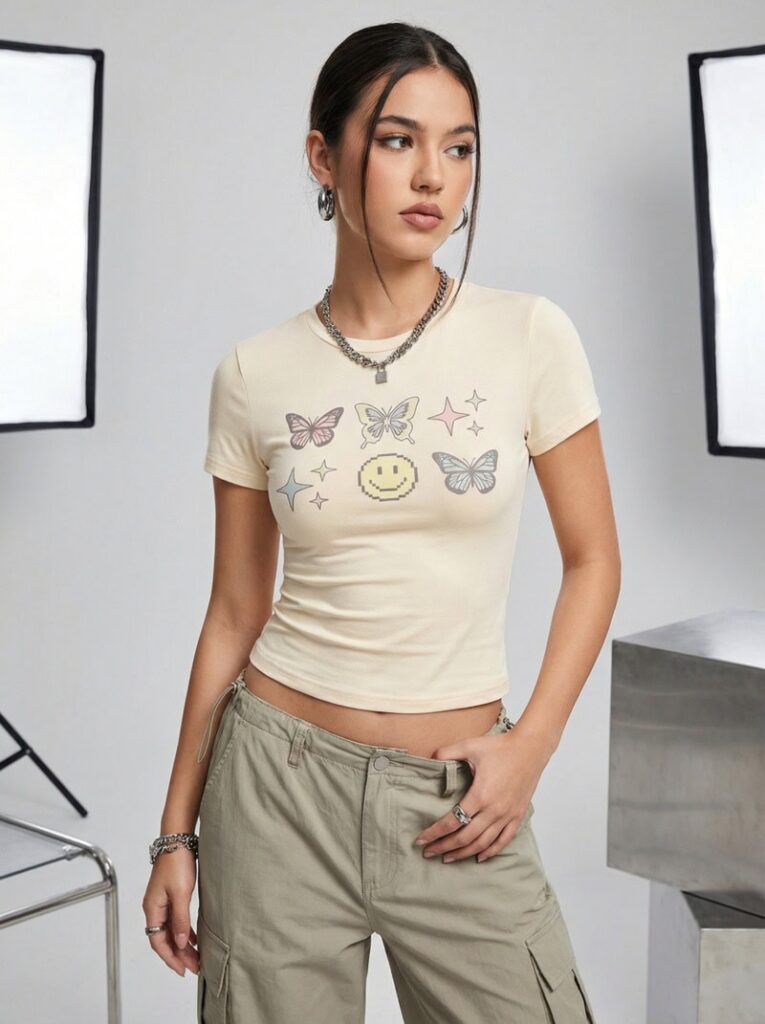
Once a strong base concept is selected, proceed to refinement using AI Inpainting to enhance graphic clarity, adjust fit details, and elevate presentation quality.
Step 2: Develop the Graphic or Logo Structure
At this stage, the goal is to create a clear, scalable graphic mark that works as the visual focal point of the garment. Unlike large abstract prints, logo designs emphasize structure, typography, and recognizability.
When generating logo concepts with AI, define:
- Logo style (minimal, badge, typographic, monogram, icon-based);
- Typography direction (bold, condensed, modern sans-serif, etc.);
- Icon concept or symbolic element;
- Overall structure and balance.
Logo-focused T-shirts are common in company culture shirts, team-building event apparel, startup anniversary tees, as well as campus or community group uniforms. Keep the logo clean, high-contrast, and vector-like to ensure scalability and print compatibility.
Example prompt: circular anniversary t-shirt logo, bold numeric year with brand name around outer ring, balanced badge composition, deep burgundy and cream palette, subtle vintage influence.
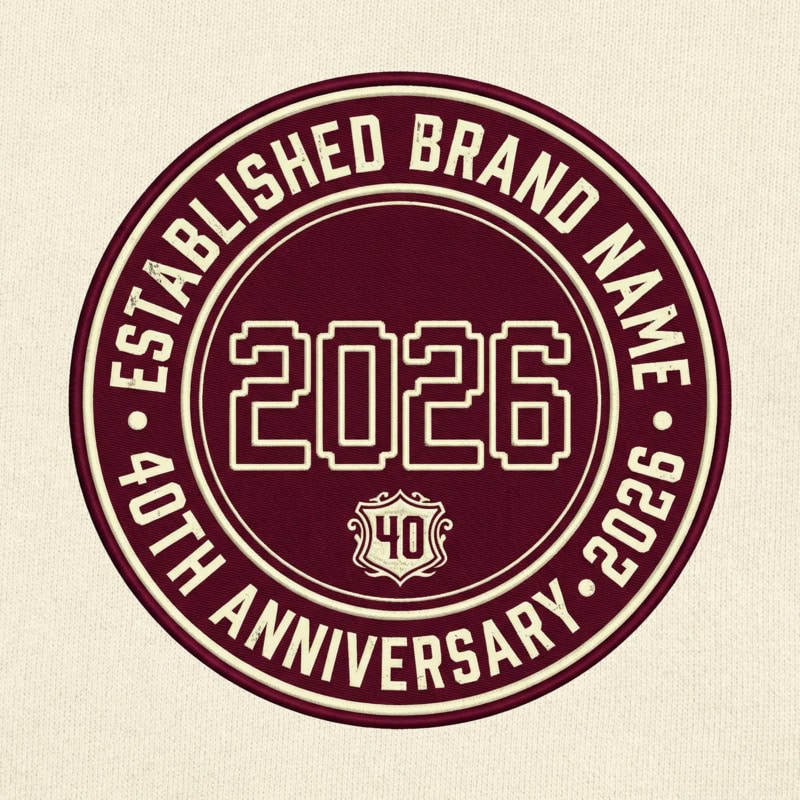
Generate multiple variations and select the version with the strongest clarity and composition.
Step 3: Apply the Logo onto the T-shirt with AI Inpainting
Once the logo is finalized, move to the garment image and use AI Inpainting to place the logo onto the T-shirt.
Select the print area (center chest, small left chest, or back placement) and insert the logo while maintaining realistic proportions and fabric interaction. Ensure the logo aligns naturally with the garment’s folds, lighting, and perspective.
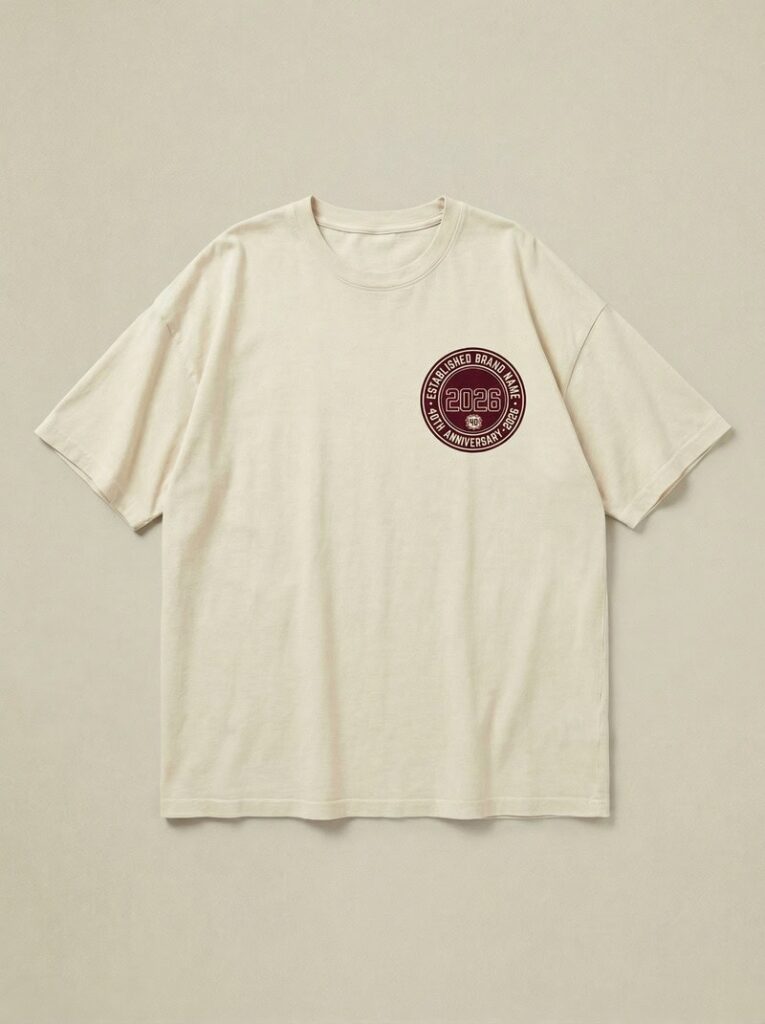
At this stage, the focus is on correct placement, scale, and integration. The logo should feel printed on the fabric, not layered artificially on top.
Step 4: Refine the Graphic with AI Inpainting
Once a strong base concept is selected, move into targeted refinement.
At this stage, focus specifically on the printed area. Select only the graphic region and enhance clarity, contrast, and print realism.
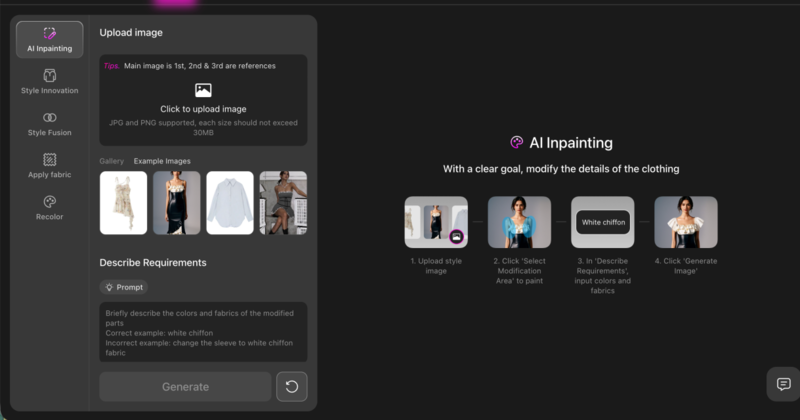
Common refinement goals include:
- Improving edge sharpness;
- Increasing contrast between print and fabric;
- Adjusting color intensity;
- Enhancing texture realism (screen print, ink texture, subtle distressing).
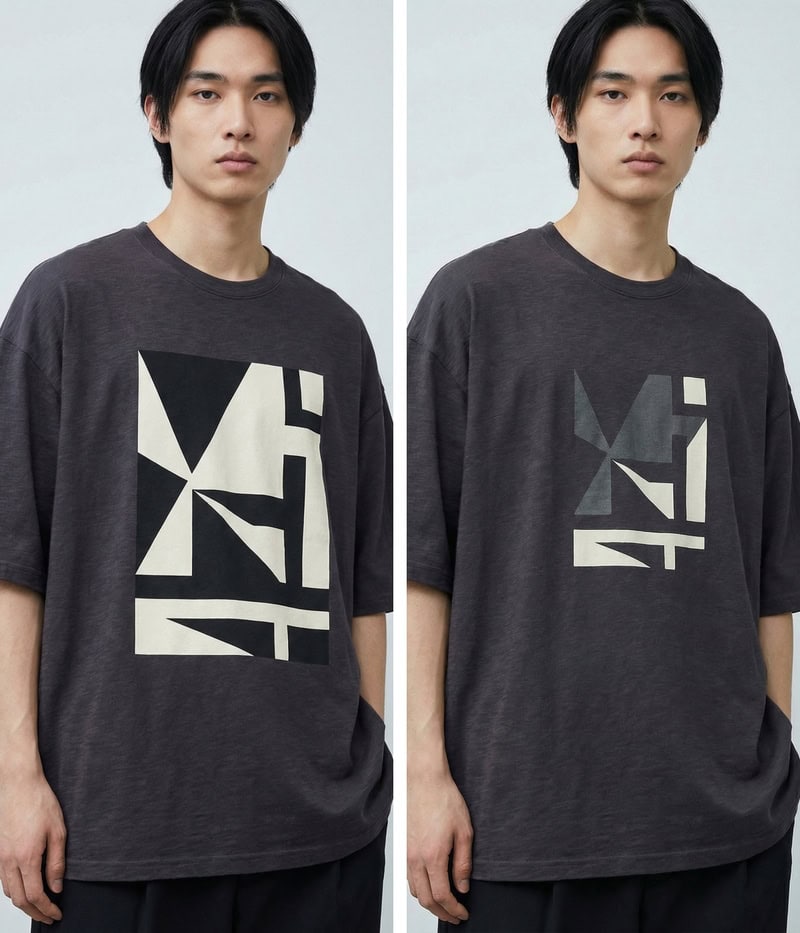
Example refinement prompt: The icons should be slightly smaller, and the edges and colors need a bit more gray tint.
Step 5: Adjust Fit, Fabric, and Construction Details
After refining the print, shift attention to the garment structure.
Use AI Inpainting to select specific areas such as sleeves, neckline, hemline, or body silhouette. Refine these elements to align with your intended positioning.
You can adjust:
- Sleeve length (short sleeve to extended sleeve);
- Silhouette (relaxed to tailored fit);
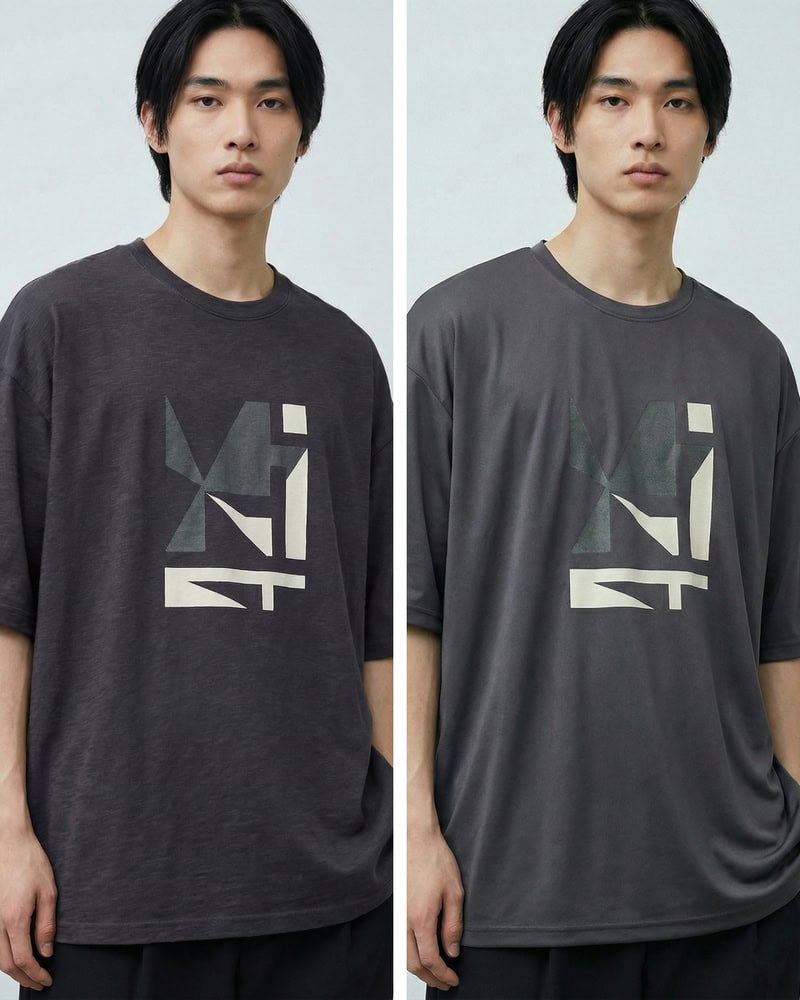
- Fabric finish (smooth cotton to washed texture);
- Structural details (ribbed collar, thicker neckline, cropped length)
Example prompt 1: Lightweight and breathable fabric suitable for sweatshirts, with a drapey feel and skin-friendly comfort.
Example prompt 2: Turn short sleeves into long sleeves.
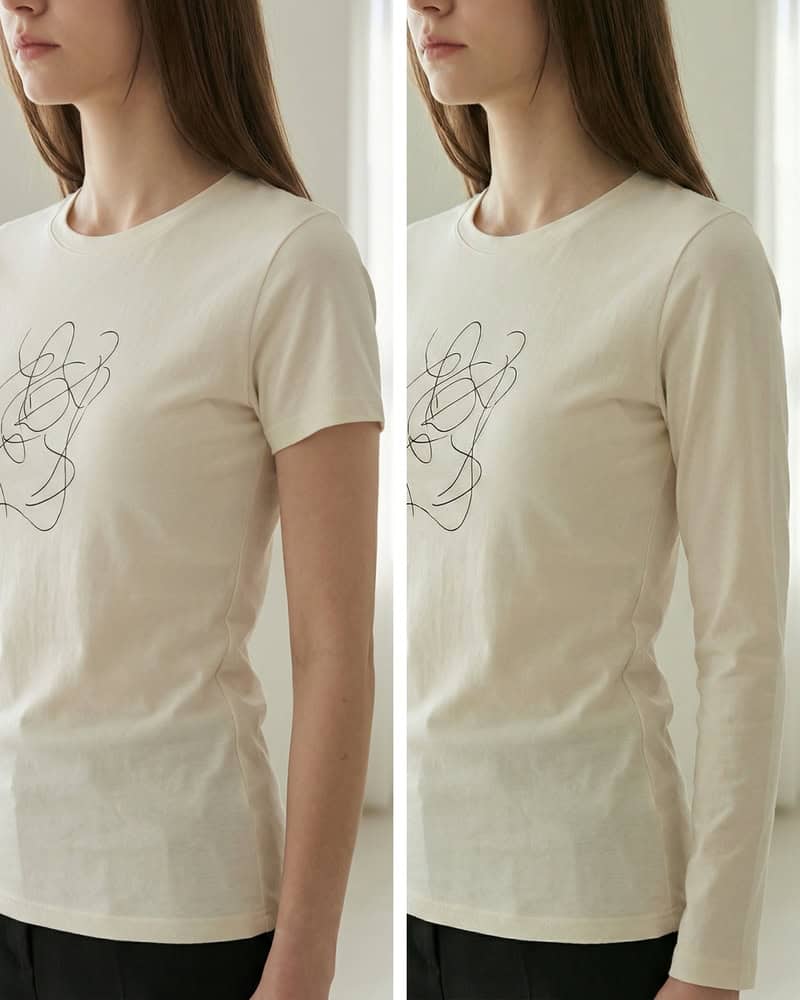
At this stage, the focus is no longer surface decoration, but garment evolution. By selectively refining sleeves, collars, fabric weight, and overall silhouette, you move from a simple mockup to a fully realized product concept. This is where an AI shirt design generator or an AI sweatshirt designer becomes especially powerful. Small structural adjustments can reposition the same graphic into a different market segment, season, or gender fit, giving your design greater commercial flexibility without starting from scratch.
Step 6: Refine and Regenerate for Final Output
After the logo has been placed onto the T-shirt, move into final refinement. At this stage, the focus is on precision and visual consistency.
Carefully evaluate the logo’s size, positioning, and proportion relative to the garment. Adjust scale if it feels too dominant or too subtle. Ensure alignment is clean and visually balanced with the neckline and overall silhouette.
Edges should appear sharp and print-ready, with strong separation between the logo and fabric color. If needed, slightly adjust color intensity to improve visibility while maintaining harmony with the garment base.
Finally, review the overall composition at different viewing distances. Zoom in to inspect detail quality and zoom out to assess impact. If the balance still feels off, regenerate subtle variations until the design feels cohesive, realistic, and ready for production.
Real–World Examples: How Leading Fashion Brands Are Using AI Design
AI is no longer a future concept in fashion. Many well-known brands are already integrating generative AI into their creative workflows to spark design innovation and push creative boundaries. These real-world examples show how AI can complement human imagination, rather than replace it, making the design process more exploratory and expressive.
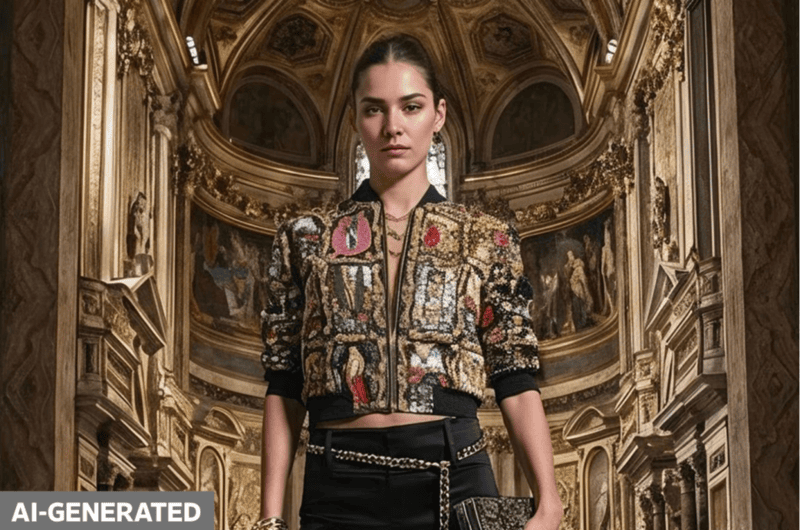
1. Alice + Olivia
Stacey Bendet, founder of Alice + Olivia, has openly embraced AI as a creative tool within her design team. The brand used generative AI platforms such as Leonardo AI and Adobe Firefly to create print designs for a recent collection, exploring new visual ideas based on earlier brand work and feeding those back into the design pipeline. This example shows how AI can spark fresh graphics that designers can refine further.
2. Levi’s
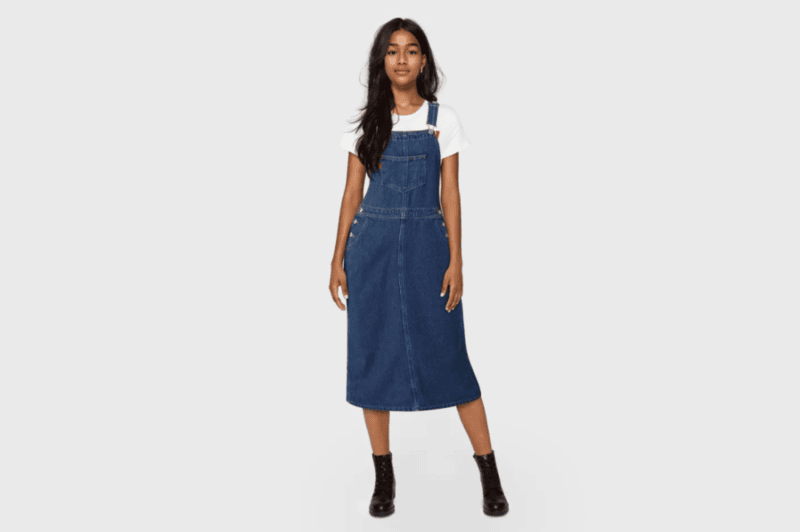
Iconic denim brand Levi’s has incorporated AI into its creative process to generate and refine denim styles. By using generative AI in early design stages, Levi’s can quickly test variations of textures, shapes, and garment concepts before finalizing prototypes, enabling faster iteration while keeping the brand’s heritage intact.
3. Moncler
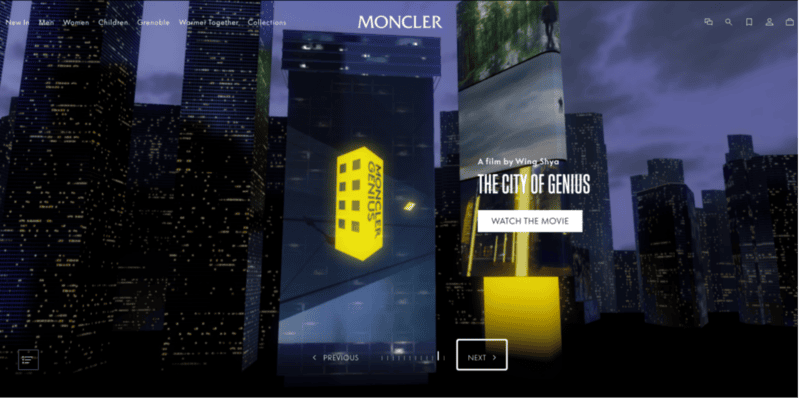
Italian luxury label Moncler worked with AI technology to explore novel garment concepts, including its AI-influenced Genius collection. Generative AI helped produce new ideas for quilted jacket textures and design elements that pushed boundaries beyond conventional methods, demonstrating how AI can influence the actual clothing design process rather than remaining a marketing gimmick.
4. Tommy Hilfiger
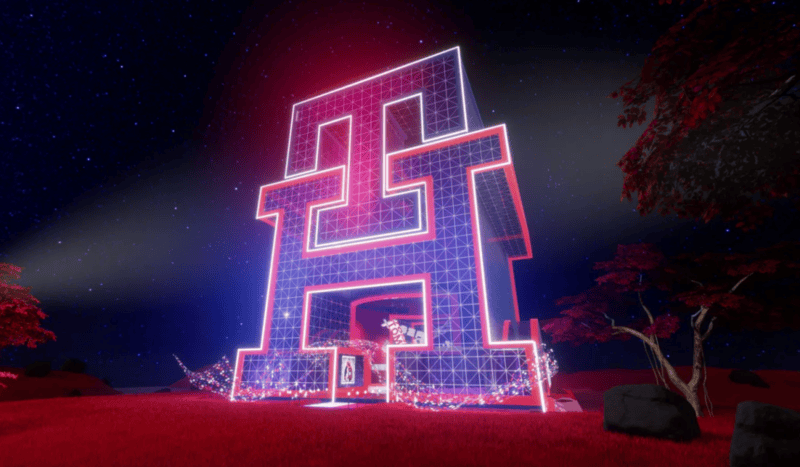
During the Metaverse Fashion Week, Tommy Hilfiger partnered with the Fashion Innovation Agency to let participants create preppy-style garments through prompt-based generative tools. The exercise generated diverse garment concepts and provided insights into emerging preferences, a form of AI-assisted co-creation that directly informs design thinking.
What These Examples Tell Us
Across these brands, AI is used not as a shortcut to replace designers, but as a creative engine that:
- Expands the range of design possibilities;
- Accelerates ideation cycles;
- Unearths unexpected concepts and visual directions;
- Fosters collaborative experimentation between humans and machines.
By combining human intuition with generative tools, leading fashion labels are demonstrating that AI can enhance both imagination and output. This is a perspective that’s directly relevant to how you can approach your own AI T-shirt design workflows.
Common Mistakes in AI T-shirt Design
While AI dramatically accelerates the design process, strong results still depend on clarity, intention, and critical evaluation. Many unsatisfactory outputs are not caused by the tool itself, but by avoidable workflow mistakes.
Here are the most common pitfalls in AI T-shirt design, and how to avoid them.
1. Writing Overly Vague Prompts
Prompts like cool graphic t-shirt or modern streetwear design lack specificity. AI systems respond best to structured input.
Instead of general descriptions, define:
- Silhouette;
- Fabric type;
- Graphic scale and placement;
- Color relationship;
- Intended presentation (ecommerce, editorial, product shot).
Specific prompts produce consistent, production-ready results.
2. Ignoring Garment–Graphic Balance
A strong graphic does not automatically make a strong T-shirt.
Common imbalance issues include:
- Oversized prints overwhelming slim silhouettes;
- High-detail graphics placed too small to read clearly;
- Low contrast between print and base garment.
Always evaluate composition at both close range and thumbnail scale. A design must remain clear in product listings and mobile views.
3. Overcomplicating the Design
AI makes it easy to generate visually complex outputs. However, excessive layering, glow effects, or intricate textures may not translate well to physical printing.
If the design will be screen printed or DTG printed, consider:
- Color count;
- Edge sharpness;
- Contrast clarity;
- Print feasibility.
Simplification often improves commercial viability.
4. Neglecting Fabric Realism
Flat, textureless garments reduce perceived quality. If fabric weight, folds, or material finish are inconsistent, the design feels artificial.
Even subtle refinements, including adjusting cotton texture, adding natural fabric drape, or enhancing lighting consistency, significantly improve realism and perceived value.
5. Skipping Iterative Evaluation
AI design is not a one-click process. Strong results typically emerge through controlled iteration.
Instead of accepting the first output:
- Generate multiple variations;
- Compare composition and clarity;
- Refine specific areas using targeted adjustments;
- Reassess overall cohesion.
Professional AI T-shirt design relies on direction and decision-making, not randomness.
By avoiding these mistakes, you transform AI from a novelty tool into a structured creative system. The difference between average and production-ready output lies in intentional refinement.
Learn More About AI Fashion Design with Fashion Diffusion
AI fashion design is not about replacing creativity. It is about expanding it. The real advantage lies in how quickly ideas can be visualized, tested, refined, and repositioned within a structured workflow.
From graphic experimentation to silhouette adjustments, from fabric simulation to market-ready mockups, AI fashion generators enable designers to move beyond static concepts and explore dynamic iterations with unprecedented speed. As generative workflows continue to evolve, those who learn to direct AI tools effectively will gain a powerful competitive edge in modern apparel design.
If you are ready to push your creative boundaries, explore new graphic directions, and streamline your T-shirt development process, start experimenting with AI fashion design tools like Fashion Diffusion. The next breakthrough in your design workflow may begin with a single prompt.
FAQ
AI T-shirt design refers to the use of generative AI systems to create apparel graphics, logos, and on-garment mockups through descriptive prompts or visual references. Instead of manually building artwork, designers guide the system with structured input describing silhouette, fabric, and graphic direction. The AI then produces visual concepts that can be refined through iterative adjustments.
In most cases, AI-generated designs can be used commercially, but usage rights depend on the platform’s licensing policy. Before launching products, it is important to confirm that your chosen AI shirt design generator allows commercial use and provides sufficient image resolution for production. When properly licensed, an AI T-shirt design can support print-on-demand stores, independent brands, and e-commerce businesses.
Yes. One of the key advantages of an AI shirt design generator is accessibility. AI tools focus on structured prompting and refinement. Beginners can concentrate on defining aesthetic direction and garment style rather than mastering technical execution. However, achieving strong results still requires clear input and thoughtful evaluation.
An AI sweatshirt designer typically emphasizes heavier fabrics, thicker construction details, and seasonal silhouettes. While the core generative process is similar, sweatshirt design requires attention to ribbed collars, sleeve volume, fleece texture, and garment weight.
To improve results with AI T-shirt design, focus on clear concepts and small refinements. Define the silhouette, fabric, and graphic direction first, then generate multiple variations to compare. Instead of starting over each time, adjust placement, contrast, and texture step by step. This structured approach helps an AI shirt design generator produce more consistent and commercially usable outcomes.


